Pickleball on a Tennis Court: What Changes
One pickleball court fits easily inside the baseline area of a single tennis court, and a full 60 by 120 foot tennis court enclosure can typically be striped for up to 4 pickleball courts using temporary lines.

A huge share of recreational pickleball is played on tennis courts, either informally with tape and a portable net for an afternoon, or as a permanent multi-court conversion at a club or park. The two sports share enough court space that this works well, but the net height, line placement, and total court count are all different enough that you cannot just show up and use tennis lines as-is. Here is what actually changes.
Can you play pickleball on a tennis court?
Yes, and it is one of the most common ways people first try the sport. A single tennis court, with its full length and width, comfortably contains one regulation pickleball court (20 by 44 feet of playing surface) within the existing baseline-to-baseline footprint, using either the tennis center line and net posts as a rough reference, or a separate portable net and taped lines placed anywhere convenient within the tennis boundary. Public parks departments do this constantly with temporary chalk or tape for pickleball-specific hours.
Is the net height different between tennis and pickleball?
Yes, and this is the detail people get wrong most often. A pickleball net is 36 inches tall at the sidelines and 34 inches tall at the center, with a shallow dip built in. A tennis net is taller and shaped the opposite way: it sits higher at the net posts and lower in the middle, and its overall height does not match pickleball's numbers. Using the existing tennis net as-is for pickleball changes the game noticeably, since the net height directly affects how easy it is to hit a ball over versus into the net. Most temporary conversions solve this by setting up a separate, correctly-sized portable pickleball net inside the tennis court rather than trying to adjust the tennis net's straps and cranks to a height it was not built for.
What kind of net works best for a temporary conversion?
A wheeled, portable net that can be rolled onto the court, set up, and rolled off again is the standard solution, since you are not permanently altering the tennis court's own net posts. A straightforward wheeled option like BAGAIL Portable Pickleball Net Set with Wheels covers the regulation width and height for casual use. For anyone setting up and tearing down more precisely, a net with a hand-crank tensioning system, such as TYRSEN Pro 22ft Pickleball Net with Hand Crank Tension System, makes it easier to hit the correct 34 inch center height every time rather than eyeballing it. A 2-in-1 style net built to convert between regulation sizes, like Onix Pickleball 2-in-1 Regulation-Size Portable Net and, is another option some facilities keep on hand for mixed tennis and pickleball scheduling.
How do you mark temporary pickleball lines on a tennis court?
Since a tennis court's existing painted lines do not match pickleball's dimensions, most temporary setups use removable court marking tape laid directly over or alongside the tennis lines, then pulled up after the session. A basic tape kit such as Professor Pickleball Court Tape or a longer roll like Copatocacy Pickleball Court Tape 2" x 262ft works for a single afternoon or weekly rotation without leaving residue on the tennis surface. Facilities that convert more permanently, or want lines rated to survive a full outdoor season, often step up to a weather-resistant option like HolderProf Pickleball Tape for Outdoor Court or a more complete kit such as Murray Sporting Goods Premium Pickleball Court Marking Kit, which some parks apply in a contrasting color so players can visually separate tennis lines from pickleball lines at a glance.
How many pickleball courts fit on a tennis court?
One pickleball court fits comfortably within a single tennis court's playing area with room to spare. Where it gets more interesting is a full tennis court enclosure, meaning the fenced area that includes the run-off space beyond the baselines and sidelines, which is commonly sized around 60 by 120 feet. That larger footprint is generally enough space to stripe up to 4 separate pickleball courts side by side, since each pickleball court plus its buffer space needs roughly 30 by 60 feet at minimum. This is exactly why so many public parks converted underused tennis courts into pickleball hubs: the land was already fenced, lit, and sized almost perfectly for a 4-court pickleball layout.
| Tennis space | Typical size | Pickleball courts that fit |
|---|---|---|
| Single tennis court, baseline to baseline | Roughly 36 by 78 ft playing lines | 1 court |
| Full tennis court enclosure with run-off | About 60 by 120 ft | Up to 4 courts |
Do you need to remove the tennis net posts to add pickleball courts?
Not for a temporary or seasonal setup. Most conversions simply add portable nets in new positions and leave the tennis posts in place, especially if the court still needs to serve tennis players at other times. Permanent, full-time pickleball conversions sometimes do remove or relocate the tennis posts to free up sightlines and avoid confusion, but that is a facility-level decision, not something needed for a weekend group bringing their own equipment.
Does the tennis surface itself need any changes?
Generally no. Tennis courts are already built to a consistent, hard, outdoor-rated surface, which plays perfectly well for pickleball without modification. The only real surface consideration is that pickleball's smaller court and closer net play mean players spend more time near the net and in tight lateral movements than typical tennis rallies, so any existing cracks or uneven patches near mid-court are worth checking before a session, since they will get more foot traffic in that zone than they did for tennis.
Should permanent pickleball lines use a different color than the tennis lines?
Yes, and most facilities that convert a tennis court to permanent dual-sport use choose a contrasting color specifically to reduce confusion for players used to reading one set of lines. A common approach paints or tapes the pickleball lines in a color that stands out clearly against both the court surface and the existing tennis lines, so a player's eye can separate the two layouts at a glance rather than second-guessing which line applies during a fast rally. Facilities that only convert temporarily for scheduled pickleball hours often skip this and rely on removable tape in one consistent color, since the tennis lines are the primary layout most of the time.
How much space should be left between multiple pickleball courts on a converted tennis facility?
When striping several pickleball courts inside one tennis enclosure, leave a buffer of roughly 10 feet between adjacent courts, similar to the spacing recommended for any multi-court pickleball layout. This keeps players from stepping into a neighboring court's action while chasing a wide ball or a deep lob. Because a full 60 by 120 foot tennis enclosure is a fixed size, fitting 4 courts with adequate spacing usually means each individual court sits close to the 30 by 60 foot minimum footprint rather than the more generous 34 by 64 foot preferred size, which is a reasonable tradeoff for recreational and club-level play.
Can players get confused switching between tennis and pickleball on the same court?
It happens, especially early on, since the eye has to learn to ignore one set of lines while focusing on the other. Using a clearly contrasting line color, keeping court signage or a posted schedule at shared facilities, and, where possible, using a different net entirely rather than adjusting a shared net between uses all reduce this confusion in practice. Facilities that host both sports regularly tend to settle on one clear visual system rather than relying on players to remember which lines matter during which hours.
Is it worth converting a full tennis facility permanently, or keeping it flexible for both sports?
This usually comes down to demand. A club or park with strong ongoing interest in both sports often keeps a facility flexible, using temporary tape or paint that can be reset between scheduled hours, so neither sport permanently loses court access. A facility seeing pickleball demand consistently outpace tennis use is often better served by a permanent conversion with dedicated lines, dedicated nets, and proper court-to-court spacing built in from the start, since a permanent layout tends to hold up better over time than repeatedly reapplied temporary lines.
If you are deciding between a temporary tennis court conversion and building a court from scratch, the tradeoffs come down to convenience versus permanence: see the full comparison in how to build a backyard pickleball court, or check exact spacing with the court size calculator before you tape anything down.
Gear mentioned in this guide
 BAGAIL Portable Pickleball Net Set with Wheels
  Onix Pickleball 2-in-1 Regulation-Size Portable Net and
  Professor Pickleball Court Tape
 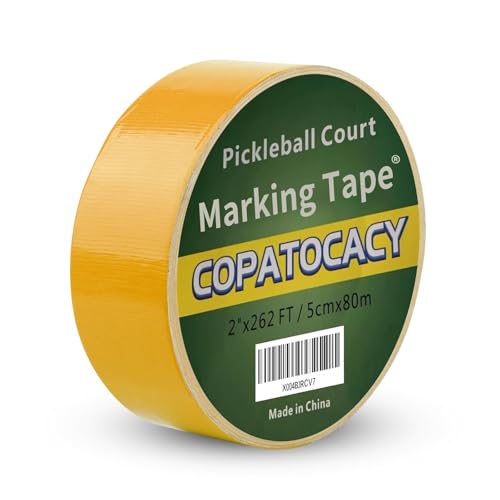 Copatocacy Pickleball Court Tape 2" x 262ft
  HolderProf Pickleball Tape for Outdoor Court
  Murray Sporting Goods Premium Pickleball Court Marking Kit
 Email me this guide's gear list
Every item on this page with its current price, in one email, so you can shop it later or in pieces. No sales sequence.
Used only to send the list. You can also just read it here.Frequently asked questions
Can you play pickleball on a regular tennis court?
Yes. A single tennis court easily contains one full pickleball court within its existing baseline area. Most temporary setups add a separate portable pickleball net and taped lines rather than reusing the tennis net and lines directly.
How many pickleball courts fit inside a tennis court?
One pickleball court fits within a single tennis court's playing lines. A full tennis court enclosure with run-off space, often around 60 by 120 feet, can typically be striped for up to 4 separate pickleball courts.
Is a tennis net the right height for pickleball?
No. A pickleball net is 36 inches at the sidelines and 34 inches at the center, while a tennis net is taller overall and shaped the opposite way, higher at the posts and lower in the middle. Most conversions use a separate portable pickleball net instead.
How do you mark pickleball lines on a tennis court temporarily?
Removable court marking tape is the most common method, applied directly on or alongside the existing tennis lines and pulled up afterward. Weather-resistant tape options exist for setups that stay down for a full season.
Do you need to remove the tennis net to play pickleball?
No, for a temporary setup the tennis net and posts can stay in place while a separate portable pickleball net is set up nearby. Only permanent, dedicated pickleball conversions typically remove or relocate the original tennis net posts.
Is the tennis court surface suitable for pickleball without changes?
Yes, the hard outdoor surface used for tennis courts works fine for pickleball without modification. The main thing to check is wear near mid-court, since pickleball involves more lateral movement close to the net than typical tennis play.
General information and estimates, not professional advice. Check local permits, setbacks and HOA rules and get local quotes before building.