Swing Weight vs Twist Weight in Pickleball
Swing weight measures how heavy a paddle feels when swung end to end, while twist weight measures how much it resists twisting on off-center hits; both matter more than the number on the box.

What is swing weight in pickleball?
Swing weight describes how heavy a paddle feels while you are actually swinging it, as opposed to how much it weighs sitting still on a scale. It depends on both the paddle's total mass and how far that mass sits from the handle, which is why two paddles with the same static weight can feel completely different in your hand. A paddle with more mass out toward the tip has a higher swing weight and generates more pop on drives and serves, at the cost of feeling slower to bring back for quick net exchanges. Run your baseline numbers through our swing weight calculator before you start experimenting with added weight.
What is twist weight and why does it matter?
Twist weight, sometimes called polar moment, measures how much a paddle resists rotating in your hand when you hit the ball off the center of the face. A paddle with higher twist weight stays more stable on a mishit near the edge, which shows up as fewer weak, twisted returns on shots that do not land dead center. Twist weight is controlled mainly by how mass is distributed toward the edges of the paddle head, separate from how far it sits from the handle, which is what makes it a genuinely different property from swing weight rather than another way of describing the same thing.
Why is not a paddle's listed static weight enough information?
The number printed on a box or listing is static weight, the paddle's total mass measured at rest. Two paddles can share that exact number and still play completely differently, because static weight says nothing about where that mass sits. A paddle built with more material near the handle can feel notably lighter in your swing than a paddle of the same static weight built with more material near the tip, and it will also behave differently on off-center contact. If you only shop by the ounce figure on the label, you are missing the two properties that most directly shape how a paddle actually feels in play.
How does lead tape placement change swing weight and twist weight?
Where you place lead tape on a paddle changes which property it affects most. Tape added near the top edge of the paddle head, at the 12 o'clock position, sits farthest from the handle and raises swing weight the most, adding pop and power to drives at the cost of a slower recovery on fast exchanges. Tape added at the side edges, around 3 and 9 o'clock, raises twist weight more than swing weight, adding stability on off-center hits without adding as much raw power. Tape added near the throat or handle barely changes either property, since it sits close to your grip.
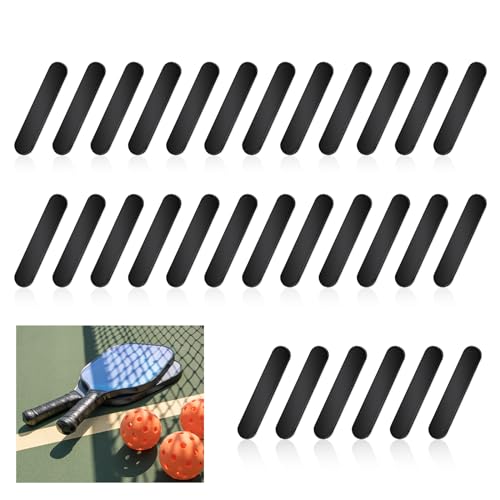
A product like MIGHTY HALO Lead Tape for Pickleball Paddles or AccEncyc 30pcs Lead Tape for Pickleball Paddles 3g Weighted lets you add small, precise amounts, often 1 to 4 grams at a time, so you can nudge swing weight or twist weight independently rather than guessing with a single large piece. Our guide to adding lead tape covers exact placement and gram amounts in more detail.
Does our swing weight calculator give a lab-accurate number?
No, and it is worth being direct about that. Our swing weight calculator produces a relative index built from a paddle's static weight, length, and balance point, useful for comparing paddles against each other or tracking how an addition of lead tape shifts a given paddle. It is not a substitute for a lab measurement taken on calibrated swing weight equipment, and it should not be treated as an exact physical unit. Use it to compare before and after a change, not to claim a precise absolute number.
How much lead tape should I add, and where?
Start small. Add 2 to 4 grams at a time and hit for a full session before adding more, since swing weight and twist weight changes compound quickly and are much easier to add than to remove cleanly. If your drives and serves feel underpowered but your dinks and blocks feel fine, add tape near 12 o'clock in small amounts. If your problem is specifically weak or twisted returns on shots you do not hit dead center, add tape at 3 and 9 o'clock instead. A heavier tungsten option like Pickleball Effect Weighted Tungsten Tape for Pickleball Paddles packs more mass into a smaller strip when you need a bigger change without adding excess surface area, while a lighter option like Neobadge Lead Tape for Pickleball Paddles with High-Performance suits fine-tuning.
Placement at a glance
| Placement | Mainly affects | Typical effect |
|---|---|---|
| 12 o'clock, top edge | Swing weight | More power on drives and serves, slower recovery |
| 3 and 9 o'clock, side edges | Twist weight | More stability on off-center hits |
| Near the throat or handle | Neither much | Small overall weight increase only |
How do manufacturers measure swing weight in a lab?
Lab-grade swing weight is typically measured with a specialized machine that rotates the paddle around a fixed pivot point near where a wrist would sit and records the resistance to that rotation, producing a single number expressed in a standardized unit. Twist weight, or polar moment, is measured separately by rotating the paddle around its own long axis instead. These measurements require calibrated equipment that individual players and most retailers simply do not have access to, which is exactly why a home or web-based calculator, including ours, works from simpler inputs like static weight, length, and balance point rather than replicating that lab setup directly.
Common mistakes when tuning swing weight and twist weight
The most common mistake is adding a large amount of lead tape all at once rather than testing small increments over several sessions, which makes it hard to isolate whether a change actually helped or simply changed the paddle in a way that needs time to adjust to. A second mistake is adding tape purely by feel without identifying the specific shot problem first, weak drives point toward swing weight, weak off-center returns point toward twist weight, and adding tape in the wrong spot can leave the original issue unresolved while adding unwanted weight elsewhere. A third mistake is forgetting that any added weight also raises the paddle's total static weight, so a player near the top of their comfortable weight range should be more conservative with total lead tape added than a player starting from a lighter paddle.
How does swing weight differ from just adding a heavier paddle?
Buying a heavier paddle outright changes total static weight everywhere at once, while targeted lead tape changes swing weight or twist weight specifically at the location you place it, leaving the rest of the paddle's balance closer to its original design. This is why two players can both want more power but reach for different solutions: one might prefer a heavier paddle from the start, like the HEAD Gravity Tour 2025 Pickleball Paddle at roughly 8.5 ounces, while another prefers to start with a lighter paddle and add lead tape only at 12 o'clock to raise swing weight without increasing overall bulk everywhere. Neither approach is wrong, they simply solve the same problem from different starting points, and the right one for you depends on whether you already like everything else about your current paddle or are still shopping for a new one entirely.
Buying tips and elbow safety
Adding weight of any kind increases the load your elbow and shoulder absorb on every swing, so add it gradually and stop if you notice new soreness. Anyone with a history of tennis elbow or shoulder pain should check with a doctor or physical therapist before meaningfully increasing swing weight. Everything above reflects published paddle specifications and general equipment tuning practice rather than in-person testing, so treat gram amounts as a starting point to adjust based on how your own arm and game respond.
Frequently asked questions
Gear mentioned in this guide
 AccEncyc 30pcs Lead Tape for Pickleball Paddles 3g Weighted
  Neobadge Lead Tape for Pickleball Paddles with High-Performance
  ArlinaL Lead Tape for Pickleball Paddles
  Retrora 20pcs Pickleball Lead Tape
  Paddle Tuning Tape for Pickleball Paddles
  Pickleball Effect Weighted Tungsten Tape for Pickleball Paddles
 Email me this guide's gear list
Every item on this page with its current price, in one email, so you can shop it later or in pieces. No sales sequence.
Used only to send the list. You can also just read it here.Frequently asked questions
What is the difference between swing weight and twist weight in pickleball?
Swing weight is how heavy a paddle feels when swung end to end, driven mostly by how far the mass sits from the handle. Twist weight is how much a paddle resists rotating in your hand on an off-center hit, driven mostly by mass near the edges of the head. Two paddles with identical static weight can differ in both.
Why is a pickleball paddle's static weight not enough to judge how it plays?
Static weight only tells you total mass, not where that mass sits. A paddle with mass concentrated near the tip swings heavier and feels more powerful than a paddle of identical static weight with mass near the handle. Swing weight and twist weight, not the ounce number on the label, drive most of the actual feel.
Where should I put lead tape to add power?
Add small amounts, 1 to 4 grams at a time, near the 12 o'clock position at the top edge of the paddle head. This position sits farthest from the handle and raises swing weight the most, which typically adds pop to drives and serves at the cost of slightly slower recovery on fast net exchanges.
Where should I put lead tape to reduce twisting on off-center hits?
Add small amounts near the 3 and 9 o'clock positions, the side edges of the paddle head. This raises twist weight more than swing weight, which helps the paddle stay stable and reduces weak or twisted returns on shots that miss the center of the face.
Is a swing weight calculator as accurate as a lab measurement?
No. A swing weight calculator built from static weight, length, and balance point gives a relative index useful for comparing paddles or tracking a change, not a lab-accurate physical measurement. Treat the number as directional, and use it mainly to compare a paddle before and after a change like added lead tape.
Can adding lead tape hurt my elbow?
It can if you add too much too quickly, since more weight and higher swing weight increase the load on your elbow and shoulder with every swing. Add weight in small increments, play a full session before adding more, and check with a doctor or physical therapist if you have a history of tennis elbow or joint pain.
Researched general guidance, not professional or medical advice. Heavier and head-heavy setups add load on the elbow and shoulder; ask a doctor or physical therapist about joint pain.