Best Carbon Fiber Pickleball Paddles (2026)
The JOOLA Ben Johns Perseus Pro IV 16mm Pickleball Paddle (about $150) is our top pick for a carbon fiber paddle: a 16mm elongated raw carbon fiber paddle at about 7.9 ounces built for a tour level player.

7.9 oz listed · 16 mm core · elongated shape · carbon fiber face
Beginner, intermediate and expert picks
Beginner
 SVICX Pickleball Paddles,Carbon Fiber Pickleball Paddle,16mm$25.99
The SVICX Pickleball Paddles, Carbon Fiber Pickleball Paddle, 16mm, brings a genuine carbon fiber face on a 16mm elongated core to a starter price under $30. It will not have the refined balance or finish of a $150 paddle, but it proves that a carbon fiber face is not automatically expensive.
Check priceIntermediate
 CPX Pro Carbon Fiber Pickleball Paddle$89.99
The CPX Pro Carbon Fiber Pickleball Paddle pairs a carbon fiber face with a polymer honeycomb core at about 8.2 ounces for under $90, a common mid market recipe. Compared to the Beginner tier, the build and finish are more consistent, though the core recipe is not fundamentally different, carbon fiber over a honeycomb core, just executed with more attention to balance.
Check priceExpert
 JOOLA Pro V Pickleball Paddle$299.95
The JOOLA Pro V Pickleball Paddle is a 14mm elongated carbon fiber paddle at about 8.1 ounces near the top of this catalog's price range, built for a player who wants a tour level finish and is already dialed in on their preferred thickness and shape. Compared to the Intermediate tier, most of what you are paying for is refinement and consistency rather than a new material or construction concept.
Skip it if:A casual or once a week player, since the price gap over a $90 carbon fiber paddle buys mostly incremental polish rather than a proportionally bigger jump in performance.
Check priceWhat makes carbon fiber a good pickleball paddle face?
Carbon fiber is valued as a paddle face material mostly for two reasons: it holds its stiffness and pop over more months of hard play than a softer material, and its texture, especially in a raw or unpainted finish, grips the ball well enough at contact to generate meaningful spin. Run your preferred core thickness through the paddle thickness calculator before you shop, since carbon fiber shows up across every thickness in this catalog rather than being tied to one specific core.
Carbon fiber is not the only face material that works. Fiberglass and graphite faces, common on many beginner paddles, tend to feel a little softer on contact and can be more forgiving early on, at the cost of losing pop somewhat sooner with heavy use. Carbon fiber has become the more common choice as players move up in price and experience, but the SVICX Pickleball Paddles, Carbon Fiber Pickleball Paddle, 16mm shows that a carbon face is available well under $30 if you want to start there directly rather than working up to it. Our carbon fiber vs fiberglass vs graphite guide compares all three face materials directly.
Raw carbon fiber vs painted carbon fiber
Within carbon fiber paddles, finish matters almost as much as the material itself. A raw or unpainted carbon face, like the one on the Engage Pursuit Pro EX Raw Carbon Pickleball Paddle, keeps the natural texture of the weave exposed, which grips the ball more and produces more spin than a smoother, painted carbon surface of the same underlying material. A painted carbon face can still spin the ball reasonably well and often looks cleaner for longer, so the choice between the two is partly about how much spin you want to prioritize and partly about appearance and durability preferences. Several paddles marketed with a T700 or T700SC designation, a specific higher grade carbon weave, pair that grade with a raw finish for exactly this reason. If maximizing spin specifically, rather than carbon fiber generally, is your main goal, our dedicated paddles for spin guide narrows the field further around raw and T700 finishes.
What core thickness pairs best with a carbon fiber face?
Carbon fiber face material and core thickness are separate decisions, and carbon fiber pairs well with any of them. A 16mm core, like the one on the CRBN Pickleball X Series Power Paddle or the Diadem Edge 18K Pickleball Paddle, keeps a carbon face's spin while adding control and a softer feel. A thinner core, like the 10mm on the Gamma Airbender Carbon Fiber Pickleball Paddle, keeps the same carbon face spin while prioritizing pace instead. Neither is a better use of a carbon face; it depends on whether you want spinny control shots or spinny power shots. Our core thickness guide breaks down all three common thicknesses in more depth.
Carbon fiber paddle options compared
| Paddle | Price | Core | Finish | Best for |
|---|---|---|---|---|
| SVICX Pickleball Paddles,Carbon Fiber Pickleball Paddle,16mm | about $26 | 16mm elongated | Carbon fiber | Cheapest genuine carbon fiber paddle here |
| Selkirk Sport SLK Atlas Max Pickleball Paddles | about $64 | Honeycomb core | Carbon fiber | Budget mid market option |
| CPX Pro Carbon Fiber Pickleball Paddle | about $90 | Honeycomb core, 8.2 oz | Carbon fiber | Common mid market recipe |
| JOOLA Pro V Pickleball Paddle | about $300 | 14mm elongated | Carbon fiber | Tour level build and finish |
Does paddle shape change what a carbon fiber face can do?
Shape does not change the material properties of a carbon fiber face directly, but it changes how much of that face's potential a given swing can access. An elongated shape, common among carbon fiber paddles built for spin and power, stretches the hitting face longer and adds leverage, which lets a faster swing generate more racquet head speed for the carbon surface to convert into rotation and pace. A standard or widebody shape keeps the same carbon face material but in a shorter, wider, more forgiving outline, better suited to a player who wants the durability and spin benefits of carbon fiber without also taking on a narrower sweet spot. Our paddle shape guide covers the three shape families directly if you are choosing between a carbon fiber paddle in each.
Weight is a separate decision again. Carbon fiber paddles in this catalog range from about 7.5 ounces up to 8.5 ounces or more, and a heavier build adds pace at the cost of more swing effort. Heavier and head heavy paddles increase the load on the elbow and shoulder with every swing, so a carbon fiber face does not offset that cost, it is simply the surface doing the spinning regardless of how much the paddle weighs. Anyone managing joint pain or a history of tennis elbow should prioritize a midweight, 7.8 to 8.2 ounce carbon fiber paddle over a heavier one and talk to a doctor or physical therapist if pain persists.
Thermoformed carbon fiber construction
A growing share of carbon fiber paddles use a thermoformed build, which fuses the face and frame into a single molded piece rather than gluing separate layers together. This construction tends to produce a stiffer overall paddle, which can make a carbon face's pop and spin feel more immediate at contact compared to a traditionally built, glued layer paddle. Not every carbon fiber paddle uses thermoforming, and a traditionally constructed carbon fiber face still spins and holds up well, so treat thermoforming as an additional construction detail worth comparing rather than a requirement for a good carbon fiber paddle.
Do you need a $300 carbon fiber paddle?
Almost never as a first carbon fiber paddle. The jump from a $26 carbon fiber paddle like the SVICX Pickleball Paddles, Carbon Fiber Pickleball Paddle, 16mm to a $90 mid market paddle like the CPX Pro Carbon Fiber Pickleball Paddle is usually more noticeable than the jump from $90 to $300, since the underlying material and core construction are often similar across that whole range. A $300 paddle like the JOOLA Pro V Pickleball Paddle mostly buys a more refined balance, a more consistent manufacturing tolerance, and a finish built for players competing at a level where small, repeatable improvements matter. If you are not already at that level, the money is usually better spent on more court time than on the top of this price range.
How we chose these paddles
We did not play test these paddles in person. We selected paddles whose product listing explicitly states a carbon fiber face, spanning from the least expensive option we could verify up to a tour level price, and cross checked stated weight, thickness, and shape where the manufacturer's listing provided them. Where a listing left a spec blank, we did not fill it in with an assumption. Everything here comes from manufacturer specifications, USA Pickleball's approved paddle records where applicable, and verified owner reviews rather than from our own contact with the ball. We also intentionally spread these picks across the full price range rather than clustering around the middle, since carbon fiber genuinely spans from under $30 to over $300 in this catalog and a single price band would misrepresent how accessible the material actually is.
Buying tips for a carbon fiber paddle
Carbon fiber is durable, but it is not indestructible, and edge contact with a fence, the ground, or another paddle is the most common way a face gets damaged early. A length of edge guard tape is a low cost way to protect the investment on any carbon fiber paddle, especially one at the higher end of this list. And remember that heavier carbon fiber paddles still add load to the elbow and shoulder with every swing regardless of face material, so if joint comfort is a concern, prioritize a midweight paddle over chasing the stiffest, most premium carbon fiber build available.
Check the approval status of any carbon fiber paddle you are seriously considering if you plan to play league or sanctioned tournament matches. USA Pickleball maintains a list of approved paddles, and a raw or unusually textured carbon finish is exactly the kind of detail that occasionally draws extra scrutiny compared to a standard painted face, so confirming approval before you buy avoids a frustrating surprise on match day.
Frequently asked questions
Also worth considering
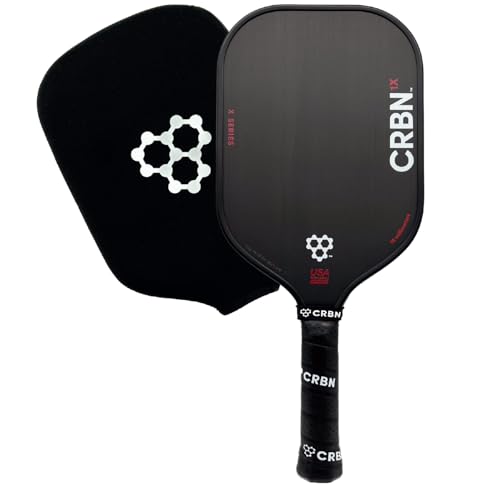 CRBN Pickleball X Series Power Paddle Full spec sheet
  Engage Pursuit Pro EX Raw Carbon Pickleball Paddle Full spec sheet
  Diadem Edge 18K Pickleball Paddle Full spec sheet
  Gamma Airbender Carbon Fiber Pickleball Paddle with Full spec sheet
  Selkirk Sport SLK Atlas Max Pickleball Paddles Full spec sheet
  11SIX24 Pickleball Vapor All Court Full spec sheet
 Email me these picks
Every item on this page with its current price, in one email, so you can shop it later or in pieces. No sales sequence.
Used only to send the list. You can also just read it here.Frequently asked questions
What is the best carbon fiber pickleball paddle?
The JOOLA Ben Johns Perseus Pro IV 16mm Pickleball Paddle, about $150, is a widely used raw carbon fiber, elongated paddle at about 7.9 ounces built for tour level play. For a lower price with the same face material, the CPX Pro Carbon Fiber Pickleball Paddle, under $90, uses a carbon fiber face on a more common mid market build.
Is carbon fiber better than fiberglass for a pickleball paddle?
Carbon fiber generally holds its stiffness and pop over more months of play and produces more spin, especially in a raw or textured finish, than fiberglass. Fiberglass tends to feel softer and more forgiving right out of the box, which can suit a newer player. Neither is universally better; the choice depends on your priorities and experience level.
What is the cheapest carbon fiber pickleball paddle?
Among paddles we track, the SVICX Pickleball Paddles, Carbon Fiber Pickleball Paddle, 16mm, is priced under $30 while still using a genuine carbon fiber face on a 16mm elongated core. It will not match the balance or finish of a $150 paddle, but it confirms carbon fiber is available well below mid market pricing.
Does raw carbon fiber wear out faster than painted carbon fiber?
Raw, unpainted carbon fiber faces can show wear and lose some grip texture faster with heavy outdoor play than a painted surface does, according to owner reviews, since there is no coating protecting the exposed weave. A painted carbon face often keeps a clean look longer but may not spin the ball quite as effectively as a raw finish.
Do I need a thick or thin core with a carbon fiber face?
Either works well with carbon fiber, since face material and core thickness are separate decisions. A 16mm core pairs carbon fiber’s spin with more control, while a thinner 10mm to 14mm core pairs the same spin with more pace. Choose based on whether your game leans toward dinking and control or driving and power.
Is a $300 carbon fiber paddle worth it for a casual player?
Usually not. A $300 paddle mostly buys a more refined balance and manufacturing consistency rather than a fundamentally different carbon fiber material than a $90 to $150 paddle. Casual and once a week players typically get more practical value from a mid market carbon fiber paddle and more court time than from the top of the price range.
Researched from published specs and verified owner reviews, not play-tested by us, and not professional advice. Heavier paddles add load on the elbow and shoulder; ask a doctor or physical therapist about joint pain.